Friday, September 17, 2010

0

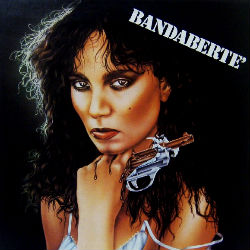
Loredana Berté: Bandaberté (GCD, 1979)

Reggae was quite of a novelty for Italian musicians, back in 1979. "Bandaberté" was one of the first pop albums to explicity flirt with that style, and surely one of the most accomplished ones. The sound is very definite and professional, well-aware of the funkiest jazz-fusion and disco music, and definitely makes the difference in making the music elegant and groovy. Loredana Bertè's coarse voice, in fact, isn't elegant at all, but undubitably gives the songs a magnetic charisma: the very spontaneous interpretations are perfect to balance the cold politeness of the arrangements.
Though upbeat rhythms are central in the album, many styles surface in the songs. There are jaunty acoustic episodes ("Colombo", "Dedicato"), and liquid synth riffs ("Robin Hood", "Agguato a Casablanca"), but most of all a bunch of memorable songs, such as the evergreen "...E la luna bussò" or the fervent Battisti cover "Macchina del tempo".

"Bandaberté" is the fourth album by calabrese singer Loredana Berté, sister of Mia Martini. The songs are written by Il volo's Mario Lavezzi (who produced the album) and such renown artists as Ivan Graziani, Lucio Battisti, Ivano Fossati.

Tracklist:
  1. ...E la luna bussò
  2. Robin Hood
  3. Peccati trasparenti
  4. Colombo
  5. Prendi fra le mani la testa
  6. Folle città
  7. Agguato a Casablanca
  8. Dedicato
  9. Macchina del tempo
Download (128 kbps)


Similar music on the blog:
Ivan Graziani: Agnese Dolce Agnese (Numero Uno, 1979)

Donatella Rettore: Kamikaze Rock'n'Roll Suicide (Ariston, 1982)

Friday, September 10, 2010

1  

Giusto Pio: Legione straniera (EMI, 1982)

I hope you'll get used to the publishing of some Battiato-related stuff every now and then in the blog's "Eighties" corner. I personally believe his school is one of the greatest moments to ever bless Italian pop music. As for today, let's concentrate on the second solo album by Giusto Pio, 1926-born violin teacher and longtime collaborator of Battiato's.

As a matter of fact, "Legione straniera" is a two-hands work by Pio and Battiato. Pio's compositional style relies mostly on his violin, and embodies an ideal trait-d'union between baroque music and postmodern minimalism. Elegance, repetition, and regularity are the key aspects of the albums, where schematic violin themes fluctuate over Battiato's straight beats, evocating sometimes an outworld placidity, other times more nervous and metropolitan ambiences.
The album collects many extra-European suggestions, but never actually sounds like world music. And despite the strong electronic architecture, the prevailing air is a noble fin de siècle mood.


Tracklist:
  1. Aria di un tempo
  2. Celestial tibet
  3. Cristina's Day
  4. Eritrea's
  5. Giardino segreto
  6. Legione straniera
  7. Ostinato
  8. Totem
Download (128 kbs):
 Megaupload
 Mediafire
 Deposit Files
Warning: the audio quality is quite bad


Similar music on the blog:
Franco Battiato: Giubbe Rosse (EMI, 1989)
Francesco Messina: Medio Occidente (Casablanca Records, 1983)

Thursday, September 9, 2010

0

Bluvertigo: Zero - ovvero la famosa nevicata dell'85 (Mescal, 1999)

A reprise of synth-pop's most dandiesque facet sharply bucked the dominating post-grunge trend of the late Nineties. Nevertheless Bluvertigo got some remarkable success by reviving the decadent sound of Depeche Mode, Berlin-era David Bowie, Japan. As a matter of fact, their aestheticism was the reverse of the medal of the "loser" mitology pervading the indie-rock ethos - another side of those years' omnipresent spleen.
Musically speaking, the album "Zero" is the most mature and varied in Bluvertigo's discography. The obvious art-rock influences reside on very solid synth-funk architectures, and the harmonic framework of the compositions is unusually clever for pop music in general. Dissonances and extra-rock chords are often used to cast an unquiet shadow on the atmospheres, and backing vocals tend to follow quite unpredictable orbits. Besides that, the music shows an unsuspected passion for rhythm inlays (quite close to Discipline-era King Crimson), and many tracks drift on a daring techno/industrial direction without abdicating to their popsong scheme.
The music conveys a sense of dissociation, but the lyrics go even further. As usual for Bluvertigo, the focus is on the feebleness of the sane/insane, reason/unconscious boundaries. The songs juxtapose partially unrelated flashes, in a style much debtor of Franco Battiato's, and definitely evocate a psychoanalytic setting. Some refrains unfortunately trivialize the overall result, but many tracks are perfect and striking.

Bluvertigo are a band from Monza, close to Milan, lead by charismatic singer/multi-instrumentist/composer Morgan (Marco Castoldi). "Zero" is their third and last studio album, featuring guest appearences by Mauro Pagani and Franco Battiato.


Tracklist:
  1. Versozero
  2. Zero
  3. La crisi
  4. sono=sono
  5. La comprensione
  6. Finché saprai spiegarti
  7. Sovrappensiero
  8. Forse
  9. Autofraintendimento
  10. Lo psicopatico
  11. Always Crashing in the Same Car
  12. Saxs Interlude
  13. Porno Muzik
  14. Niente x scontato
  15. Numero
  16. Punto di non arrivo
Donwload (160 kbps)


Similar music on the blog:
Franco Battiato: Giubbe Rosse (EMI, 1989)

Central Unit: Central Unit + Loving Machinery (M.P. Records, 2003)

Monday, September 6, 2010

1  

VV.AA..: Let's Talk about Muertepop (Muertepop, 2007)

The post-rock, indietronic, ambient, glitch, electroacoustic scenes have often met during the last decade, giving birth to a fertile ground for musical contamination. An idea of this quite poorly known territory is well sketched by this much varied compilation. The most evident defining trait of the music is the strong predominance of instrumental and electronic components: lush or barbed, layered or pointillist, most of tracks don't even feature vocals or acoustic instruments. Atmosphere overarches melody and rhythm in the constructions, and timbre acts a primary role in setting the mood of the music. The latter is mostly bleak, cold, melancholic - most of the textures are loosely structured and rarefied, or I'd better say emptied-out - but sometimes lit up by sugary ambiences loaded with hope and lyricism. There's an overall experimental tendency animating the music, though the boundary between experimentation and mannerism is often quite faded.
The tracks aren't all equally good obviously, but the variety and the representativeness of the compilation definitely makes it an interesting and pleasurable listening.

"Let's Talk about Muertepop" is the first release by young-born netlabel Muertepop, active mostly with indietronic music. The compilation features a wide inventory of artists, including quite prominent names such as Port-Royal, Ioioi, My Awesome Mixtape. It's available for free download on their website.


Tracklist:
  1. Port-Royal - Internet Love
  2. Etere - Dans les boulevards (Ohz remix)
  3. Leben - Molly Has Been Cured
  4. Mark Hamn - Akoustik Pool
  5. My Awesome Mixtape - Ode to Poetry
  6. Ioioi - Bright Future
  7. Cocoon - Neural
  8. Fever Asylum - Tomorrow You Will Listen to
  9. Livi(d)o - Qualcosa nella mia mente
  10. Guitar to Abdicate - A New Place
  11. Let's Drive to Alaska! - As We Sleep
  12. Rikieffe - Mosca ceca
  13. Overtuner - Broken Melody
  14. Monowatt - Brainwave #0
  15. Urkuma&Strinqulu - Lundulu
  16. Smart Drug - Rosina
  17. Scientist&Cynic - The quite gnome (removed)
  18. Le supersquillo - Go way John (removed) 
  19. Falter Bramnk - Big Pink
  20. Gilvia - Gls3
n.b. Tracks 17 and 18 have been removed on the label's website. If you have them please do contact me.
Download (192 kbps)

Similar music on the blog:
Tanake: 3ree (Fratto9/ Ebria, 2007)

Port-Royal: Flares (Resonant, 2005)

Monday, August 23, 2010

0

Premiata Forneria Marconi: Passpartù (Zoo Records, 1978)

P.F.M. are the giants of Italian prog-rock. Despite their celebrity, their records always showed some consistent flaws: the lack of a gifted singer; the poorness of the lyrics; the substantial unoriginality of their musical themes. "Passpartù" isn't generally regarded as their peak, but unquestionably solves two of the three problems above.
Though the singer - Bernardo Lanzetti from Acqua Fragile - doesn't have a versatile voice, the lyrics are brilliant and imaginative: they are a work by singer/songwriter Gianfranco Manfredi, who privileged levity above his usual causticity for the occasion. What's more, the music makes a resolved step towards the incorporation of folkloric material: the resulting sound is a hybrid of jazz-rock fusion in the vein of Weather Report and Mediterranean suggestions which remind of Area (compound meters in profusion!) but show a very personal acoustic edge.
Everything converges to a surprisingly breezy album, where the instrumental skill of the musicians doesn't suffocate the pop appeal of the music, but weaves smart woofs which enhance it with class and moderation .

"Passpartù" ninth studio release from P.F.M., and the second without their well-known violinist Mauro Pagani.  Many tracks feature Roberto Colombo on keyboards - later a key producer of Italian new wave.


Tracklist:
  1. Viene il santo
  2. Svita la vita
  3. Se fossi cosa
  4. Le trame blu
  5. Passpartù
  6. I cavalieri del tavolo cubico
  7. Su una mosca e sui dolci
  8. Fantalità
Download (128 kbps)


Similar albums on the blog:
Gianfranco Manfredi: Zombie di tutto il mondo unitevi (Ultima spiaggia, 1977)
Alberto Fortis: omonimo (1979)
0

Deca: Claustrophobia (Labyrinth Records, 1989)

"Soundtracks for imaginary films". The expression is much abused, but rarely fits as much as in this case. "Claustrophobia" is a deeply atmospheric record, polarized in a gloomy cyberpunk direction which easily recalls of Gary Numan's most disquieting soundscapes. But the darkness here goes further, entering the realms  of industrial music: though the sonic palette is quite different, Kirlian Camera's evocative halo is often behind the corner.
Don't think of some dull minimal-wave record, anyway. This synth-only music always shows an admirable sonic care, much far from the stereotypical amateurish sound of the Italian 80s underground. There's a strong attention to melody and timbre, and many solutions remind of progressive artists such as Goblin or J.M. Jarre: not the kind of influence usually found in post-punk stuff. Moreover, the programming work on percussions is impressively layered: the repetive metallic patterns of the synthetizers create a hypnotic rhythmic jungle which hides secret melodies right in the beats.
Some tracks feature vocals, quite unkempt as a matter of fact. They sound as if they were the usual awfully-pronounced English of Italian darkwave, but they are just meaningless syllabes - a fake idiom the author baptised "tecnoi".

Deca's is a project of Federico De Caroli's, started in the early Eighties. "Claustrophobia" is his third album, marking the depart from a Cosmic Couriers-style composition towards a darker and more personal sound. He went on along this direction, publishing many other works and attracting a small but devoted cult following.  He's still active today.


Tracklist:

  1. Inframorte
  2. Carnal Flowers
  3. Timewarp
  4. Private Panic
  5. Cathedral of Nightmares
  6. Liquid Animals
  7. Claustrophobia
  8. Metamorphosis
Download (192 kbps)


Saturday, August 21, 2010

0

La 1919: Jouer, Spielen, To Play (Materiali sonori, 1994)

Let's be sincere: free-improv stuff is usually very chaotic and/or very monotonous. It takes a fan to be fully appreciated. "Jouer, Spielen, To Play" is a bit different. Though entirely ad-libbed, it has very strong structures and dynamics. The reason is probably that its solid rhythm modules are laid by two giants of the avant-prog community: Henry Cow's Chris Cutler and This Heat's Charles Hayward.
The music, indeed, is very much in the spirit of such bands as Massacre or This Heat themselves. Kraut-rock beats (with a jazzier edge), rickety and terribly obliquous guitar lines, and that elusive air of stagnation and rot. Here, the ground-laying drums are supported by La. 1919 - Luciano Margorani (guitar, bass, loops) and Piero Chianura (sampler, synthetizer) - plus guitarist Roberto Zorzi. The tracks are much varied and definitely unmissable for every avant-prog lover.

La 1919, from Milan, published quite a lot of stuff under different names. This should be their fourth album.


Tracklist:

  1. Hanno seppellito l'uomo sbagliato
  2. Sheffield Wednesday
  3. Fate fagotto!
  4. Storie del dormiveglia
  5. Qua qua qua... Singing Ducks
  6. Donne Kamikaze
  7. Un mondo invisibile
  8. Red Wire
  9. The Drumming Talk
Download (320 kbps)


Similar albums on the blog:
Art Fleury: I luoghi del potere (Italian Records, 1980)
Tomografia Assiale Computerizzata: omonimo (Azteco, 1983)

Friday, August 20, 2010

0

Amari: Apotheke (OnDaNomala, 2002)

The indie-hop vogue hearlded elsewhere by the AntIcon label has never really caught on here in Italy. "Apotheke", a very early and paradigmatic of the tendency, seems anyway to indicate that the style would fit perfectly with our panorama.
Later works by Amari would lean in a more electropop direction, but here hip-hop is still the main course. A quirky kind of hip-hop, for sure: you get the beats, the scratches and the rap flow, but nothing sounds like the usual "posse" aesthetics of Italian hip-hop.

The musical background is full of fluffy electro sounds and acoustic guitars, in a perfect "indie" fashion, and lacks any aggressiveness. The voices - uncombactive and intriguingly arranged in half-sung vocal harmonies - are the ones of spoilt kids from the middle-class bourgeoisie, lazy university students with all eases and no will to remonstrate against anything.
And the lyrics, they wallow in their everyday uselessness: personal relations rifracted through fragmented metaphors just for the sake of sounding a bit cryptic.

Everything should point to a horribly pretentious and poor album, but for some miracle it's not like that. The songs are light, delicate and tuneful; the music and lyrics pleasantly mix genres and registers: hip-hop and indie-pop, youth slang and (wannabe) cultured terms.
So thumbs up for Amari - this time, at least. Starting from the following "Gamera", the band would become more and more annoying...


Tracklist:

  1. Camogli
  2. Pianetarock
  3. Megamedio
  4. Apotheke
  5. Letter to Kafey
  6. Ottakring
  7. Folkgalore
  8. Berlino è silenziosa
  9. Whale Grotto
Download (192 kbps)


Similar albums on the blog:
Fare soldi: Sappiamo dove abiti (Riotmaker, 2008)
Artemoltobuffa: L'aria misteriosa (Aiuola, 2007)

Friday, August 6, 2010

0

Moggi: Tra scienza e fantascienza (Omicron, 1976)

A peculiar record, bridging bebop mannerism and electronic experimentation. Synthetizer arabesques rise over exquisite double-bass grooves and jazzy drumming. Their use is much varied: from soundtrack-like melodic themes, to minimal-tinged stagnations and proto-techno burbles. The compositions are elegant, lucid, but pleasantly devoid of the bombast of much prog-rock of those years. On the contrary, the tracks are absorbed in a gassy fluctuation, slighthly futuristic, a bit Satiesque, but most of all very light and unpretentious. The imaginative work on percussions is unfortunately spoiled by the bad audio quality.

"Moggi" is an alter ego of composer Piero Umilani's. Born in 1926, he began his career in the field of film soundtracks in the late 50s. In 1964, he founded the Omicron label to publish his quite experimental "sound library" works. They were collections of instrumental tracks, thought as repertoires of possible soundtracks for TV commercials, radio backgrounds and so on. The creation of Sound Work Shop recording studio in 1968 gave a strong push to his production, and he soon began publishing something like ten albums a year. Their dominant style was much varied: for "Tra scienza e fantascienza", the inspiration was evidently sci-fi.


Tracklist:

  1. Cowboy spaziale
  2. Officina stellare
  3. Danza galattica
  4. Saltarello marziano
  5. Jingle N°1
  6. Automa
  7. Tarantellaccia
  8. Bric brac
  9. Soundmaker Blues
  10. Gadget
  11. Soft Key
  12. Happy Accompainment
  13. Futuristic Jam N°1
  14. Futuristic Jam N°2
  15. Killer Robot
Download (192 kbps)


Similar albums on the blog:

Thursday, August 5, 2010

2

Francesco Messina: Medio Occidente (Casablanca Records, 1983)

The heritage of the Cosmic Couriers, the new technologies and the beggings of synth-pop, minimalism... And the Mediterranean: the fascination for the Middle-Eastern tradition and philosophy. "Medio occidente" is on the frontier of these musical worlds, which are surprisingly close one another.
The mood reminds of a starker Vangelis, of Philip Glass, or Franco Battiato's most "ethnic" works. The latter is not a coincidence: Francesco Messina is a longtime acquantaince and collaborator of Battiato's. Most of the tracks are hypnotic instrumental wanderings, suspended in an ecstatic calm. The hushed timbres are disposed with a somehow architectural aesthetics, and the synthetic beats obey to a strictly functional logic. There's a veil of melancholy and decadence over them though, and the few tracks with vocal parts emphasize the sensation. The overall ambience is dusty and soaked with helplessness. Some retro-fashioned vocal intrusions (opera singing, craking radio excerpts) project a sense of nostalgia for the old times, probably the colonial era when Europe extended over all of the Mediterranean...

Francesco Messina was born in 1951 in Sicily, but moved to Milan tu study design. There he became involved with Franco Battiato's artistic entourage. This is his second solo album, after a lot of collaborations (both musical and graphical). He is now married with singer Alice, and he is a university professor in the field of graphic design.

(I could not find a bigger image, sorry)
Tracklist:
  1. Marcia di Kioto
  2. Harem
  3. Uffici del 126° piano
  4. Russian tea room
  5. Plaza tonal
  6. Fine novecento
  7. Club Mediterranée
  8. Comunicazioni interne
Download (210 kbps)

Similar albums on the blog:

Wednesday, August 4, 2010

0

Subsonica: Microchip emozionale (Mescal, 1999)

On the confluence of the Italian electro-dub tradition of the 90s and the new sounds coming from the UK (trip-hop, d'n'b), Subsonica hail from Turin with a very personal dance-rock formula. Based on the metallic voice of lead singer Samuel and the hi-tech beats of drummer Ninja, both trippy and driving, their music portays metropolitan sensations and paranoias in a typically late-Nineties cyberpunk fashion. But their music is not just pure dystopia: the dub/upbeat structures fill the music with open spaces. They are readily colonised by the the ultradeep and sinuous basslines, but also by more optimistic (yet very edgy) disco guitars and catchy melodies.
Quite surprisingly, most of the tracks have a (mainly implicit, but sometimes outspoken) languid allure, enhanced by the dewy synth carpets and sonic details. Another striking element is the technical complexity and precision of the weavings, rare for those years and that genre, and somehow closer to the sophistication of the most refined acts of the prog era. The ungraspable 7/8 beat of "Discolabirinto" (a dancefloor hit!) firmly points in this direction.

Subsonica were founded in 1996 in Turin. They were - and are - a quintet: voice, guitar, keyboards, bass and drums. Besides the classical rock instrumentation, their music relies heavily on programmed beats and sounds. This is their second LP.


Tracklist:

  1. Buncia
  2. Sonde
  3. Colpo di pistola
  4. Aurora sogna
  5. Lasciati
  6. Tutti i miei sbagli
  7. Liberi tutti
  8. Strade
  9. Discolabirinto
  10. Il mio DJ
  11. Il cielo su Torino
  12. Albe meccaniche
  13. Depre
  14. Perfezione
Download (240 kbps)

Giorgio Moroder: E=mc² (Durion, 1979)

Tuesday, August 3, 2010

2

La quiete: La fine non è la fine (Heroine, 2004)

Convulsive, hot-blooded, this album is internationally regarded as the masterpiece of Italian screamo. For those who are not acquainted to the term, "screamo" designates a very fiery branch of post-hardcore, which evolved from emocore starting from the mid-Nineties. Its defining traits: frantic hardcore drumming, chaotic and coarse guitar swirls, prominent soft/loud dynamics quite close to post-rock and, most of all, harshly shouted vocals - often almost unintelligible.
La quiete gained a devoted cult following thanks to their relentless live activity and their curiously ironic attitude - mostly showcased by their surreal, or even nonsensical, lyrics. Their songs are quick and tense, and their sound is just as impetuous and scratchy. Despite the chaotic feeling of their music, there is a very clever attention to structures, with an enormous density of tempo shifts and a wise ability to balance the impulsiveness with more dilated sections. These latter episodes contribute to make the album somehow dreamy and optimist despite its strongly existentialist/expressionist character: letting the everpresent melodic lines tower above the rest, they momentarily illuminate the angry desolation of the music, creating an "epiphanic" melancholy which is much similar to the one familiar to GYBE! or Explosions in the Sky fans.

La quiete was formed in 2000 in Forlì. This is their first and only album up to now.


Tracklist:
  1. Raid aereo sul paese delle farfalle
  2. Metempsicosi del fine ultimo: nevrastenica oscillazione fra poli estremi
  3. Notte dei cristalli a Rue des Trois-Freres
  4. Ciò che non siamo, ciò che non vogliamo
  5. Il destino di un ombrello
  6. Merce Cunningham
  7. Super Omega
  8. Uncaged
  9. La fine non è la fine
Download (192 kbps)


Similar albums on the blog:
Contropotere: Il seme della devianza (Skuld, 1991)
Kina: Se ho vinto se ho perso (Blu bus, 1989)

Saturday, April 24, 2010

5

Toni Esposito: Rosso napoletano (Numero uno, 1975)

Jazz and the Mediterranean: two worlds merging into one with the suspended atmospheres of "Rosso napoletano". A magical record, capturing the most alluring aspects of Bitches Brew-era Miles Davis and elevating them to an almost mystical lightness. Hypnotic funky grooves and a miniaturistic work on percussions are the key element - and the most discreet one - of the sound, equally tipified by charming keyboard brushstrokes (piano, e-piano, synthetizers, all unfolded with calm, equilibrium and an elegant sense of obliqueness) and wavering saxophone themes, metamorphosing Southern-Italian folklore into a new melodic language.
The album succeeds in being both relaxing and thrilling at the same time: its delicate stream cradles and bewitches, but the everchaning breeze of its details won't ever let you yawn.

"Rosso napoletano" is the first solo album by legendary Neapolitan session-drummer Toni Esposito, and features Robert Fix on saxophone,  Paul Buckmaster on keyboards, and Gigi De Rienzo on bass and guitars, plus many guest appearences.


Tracklist:

  1. Rosso napoletano
  2. Danza dei bottoni
  3. Il venditore di elastici
  4. Breakfast
  5. L'eroe di plastica
Download (192 kbps)


Similar albums on the blog:

Saturday, April 10, 2010

2

Giuntoli & Meroni: Diabolik e i sette nani (Rombo, 1980)

Idly couched on the confluence of progressive, jazz and "modern classical" experimentation lies "Diabolik e i Sette Nani", and it does not sound as you would expect from these few words. Don't imagine anything difficult, pretentious, or intellectual: just piano and saxophone (or clarinet, sometimes). Placid and spontaneous - even a bit tipsy, I dare say. No apparent direction: the tracks are just take-it-as-it-comes excursions through Satiesque impressions, free-jazz(y) improvisations, and facetious melodic quotations. The overall spirit might remind Robert Wyatt, but the most close comparison I can think about is the lazy melancholy of French avant-prog project ZNR (for the few ones which actually knew them).

Massimo Giuntoli and Roberto Meroni are both from Milan, where they still live and play today.


Tracklist:

  1. I racconti di Canterbury
  2. Mastro Antonio
  3. Tre movimenti per pianoforte
  4. Diabolik e i sette nani
  5. Lothrorien
Download (217 kbps, vinyl rip)

nb. The first four tracks are grouped together in one single file


Similar albums on the blog:

Friday, April 9, 2010

1  

Claudio Baglioni: Viaggiatore sulla coda del tempo (Columbia Sony Music, 1999)

Baroque pop means dressy arrangements, highfalutin melodies, and a certain amount of pretentiousness. But in the case of this album, the expression gets some additional meanings. Talking about structures, these songs don't reach the puzzling complexity of Battisti's later efforts: no deconstruction here, just verse/chorus/bridge/coda craftmanship taken to masterwork level - the quintessence of baroque aestethics. Lyrics and rhymes are of the most convoluted kind: lines and lines of far-fetched metaphores just to say one small concept, interwoven with elaborate rhyme schemes which always privilege form above content.
The arrangements are layered and affected by a purely baroque form of horror vacui: in any other context, they'd sound overproduced, but here they just fit perfectly. Blending orchestral gusts and trip-hop architectures, Fripp-like curves and abrupt world music meddlings, their amazing sound depth's a stirring counterpoint to the impressive vocal glides propelling the songs.

21th album by pop-rock superstar Claudio Baglioni, the lp is some sort of concept work about midlife and the passing of time. It was produced by Cervello's Corrado Rustici, and the drums were played by longtime Baglioni's collaborator Gavin Harrison, later of Porcupine Tree fame.


Tracklist:

  1. Hangar
  2. Un mondo a forma di te
  3. Si io sarò
  4. Stai su
  5. Caravan
  6. Mal d'universo
  7. Chi c'è in ascolto
  8. Opere e omissioni
  9. Quanto tempo ho
  10. A domani
  11. Cuore di aliante
  12. A Clà
Download (320 kbps)


Similar albums on the blog:

Tuesday, March 30, 2010

0

Touane: Figura (Persona, 2008)

Techno music can be cold, stern, alienating; it can also be delicate and fluffy though, and this is the case of "Figura". An album of watery sounds, crystalline electronic echoes, and comforting beats. Glitchy streams that never sound "broken" or disquieting, but gently cradle the listener with their progressive mutations: supple timbres, whispered vocals, pointillist percussion, slight dub tendencies... The overall flow is extremely natural and ravishing. It seems like going for a walk in the springtime, with nothing in your mind - it makes you feel the wonder of the breeze, the blossoms, the drizzles.

Touane is Marco Tonni, 1979, born in Rimini but living in Berlin since 2005. This is his sophomore full-length release.


Tracklist:

  1. Fruehstueck
  2. She Let Some Light In
  3. Pioggia
  4. Autoerotica
  5. Di sotto
  6. Take Off
  7. Figura
  8. Promenade
Download (320 kbps)


Similar albums on the blog:
Jolly Music: Jolly Bar (Nature/Wide, 2000)
miles_gurtu: omonimo (Shakti, 2004)

ps. Please join Il golpe e l'uva on Facebook to see the latest updates directly on your board!

Thursday, March 25, 2010

3

VV.AA.: Polizziotteschi Graffiti (GDM Music, 2005)

Let's make another step in the world of Italian soundtracks of the 70s. As I wrote in a previous post, this is one of the most experimental territories ever explored by Italian musicians, and one of the most varied too. A stunning trait of the genre - but rather obvious, indeed - is its "easy listening" element: though daring, often electronic, or dissonant, or fostering composite rhythms, the tracks always have a strong cynematic flow which makes them immediate and thrilling.
Most of the tracks feature exciting jazz/funk jams, impulsive and lucid, combined with captivating keyboard themes. The deep "semantic" nature of the music relies on the intuitions of composers such as Ennio Morricone, and on a series of cliché associations: horns and action, staccato figures and suspence... These standard solutions are always reworked and recombinated to form a very broad spectrum of inventions, ranging from the Moroder-like pace of "Delitto al ristorante cinese" to the uber-groovy basslines of "Nucleo antirapina".

"Poliziotteschi graffiti" is one of the many compilations recently devoted to the genre. Despite the cover, I think it's one of the best. I will post some more in the future, if you like.


Tracklist:

  1. Stelvio Cipriani - Mark il poliziotto (Mark il poliziotto, 1975)
  2. Luis Bacalov - The Summertime Killer (Ricatto alla Mala, 1972)
  3. Armando Trovajoli - Blazing Magnum (Una Magnum Speciale per Tony Saitta, 1976)
  4. Detto Mariano - Delitto al ristorante cinese (Delitto al ristorante cinese, 1981)
  5. Guido & Maurizio De Angelis - Goodbye My Friend (Il cittadino si ribella, 1974)
  6. Bixio, Fabio Frizzi, Vince Tempera - Nucleo antirapina (Operazione Kappa: Sparate a vista, 1977)
  7. Franco Micalizzi - Delitto sull'autostrada (Delitto sull'autostrada, 1982) 
  8. Goblin - Trumpet's Flight (Squadra antigangsters, 1979) 
  9. Franco Micalizzi - Special Cop (Italia a mano armata, 1976)
  10. Luis Bacalov - La polizia è al servizio del cittadino? (new edit) (La polizia è al servizio del cittadino?, 1973)
  11. Guido & Maurizio De Angelis - The Life of a Policeman (La polizia incrimina, la legge assolve, 1973) 
  12. Stelvio Cipriani - La polizia sta a guardare (La polizia sta a guardare, 1973)
  13. Goblin - La via della droga (La via della droga, 1977)
  14. Franco Campanino - Napoli si ribella (Napoli si ribella, 1977)
  15. Franco Micalizzi - Special Agents (Napoli violenta, 1976)
  16. Guido & Maurizio De Angelis - Car Chase at Margellina (Piedone lo sbirro, 1973)
  17. Guido & Maurizio De Angelis - New Special Squad (Roma violenta, 1975)
  18. Luis Bacalov - Montreal Non Stop (L'ultima chance, 1975)
Download (192 kbps)


Similar albums on the blog:
Calibro 35: s/t (Cinedelic/Self, 2008)
Ennio Morricone: Crime and Dissonance (Ipecac, 2005)

Wednesday, March 24, 2010

6

Central Unit: Central Unit + Loving Machinery (M.P. Records, 2003)

The unquiet waverings of Tuxedomoon spawned a whole school in the Italian underground. This record (a sum of two actually, see below) heralds the tendency: skeletal electronic beats and evanescent synth atmospheres, combined with mechanical basslines and relentless violin meanderings, with slothy saxophone murmurs peeping out here and there.
The music is ghostly, decadent, and subtly soggy; it never sounds epic or apocalyptic though, nor excessively amateurish (it's not minimal wave, to make a long story short). On the contrary, it sounds quite elaborate: its orbits are knotty and obliquous, and its mood is the mood of fallen aristocracy.

Central Unit were a band from Bologna. They were among the first in Italy to manipulate synths, drum machines and other electronic devices to create atmospheric soundscapes. This is a reprint of their first LP (produced by Tuxedomoon's Peter Principle), together with a preceding EP.


Tracklist:
 Central Unit LP (1983)
  1. Detective Fredd
  2. Orient-Express
  3. Mas rapido
  4. Primavera di Kaspar
  5. Grotesque
  6. Bailamme
  7. Mordor
  8. Où Papè d'Où Marcocù
  9. Aiumassah!
  10. Die Flucht Ohne Ende
Loving Machinery EP (1982)
  1. Saturday Night
  2. Rock Onze
  3. What Use? (Version)
  4. Beset City
Download (192 kbps) (re-up)


Similar albums on the blog:
Giovanotti Mondani Meccanici: GMM (Materiali Sonori, 1985)

Thursday, March 18, 2010

0

Kleinkief: Il sesso degli angeli (Srazz, 1997)

Infested by alternative rock first, and colonized by post-rock immediately afterwards, the Italian underground never really developed a noise-pop scene. "Il sesso degli angeli" then sounds like a solitary jewel, a random spark of frenzy in the boredom.
Modeled on Sonic Youth and their convulsive out-of-tune whirlpools, the songs also feature some slight dream-pop/shoegaze tendency, reflected in the cradling female voice and in the unexpected moments of quietness and suspension. But the instinctiveness of the hardcore school also illuminates the music, and so does the almost prodigious balance of raw spirituality, ingenuous literarity and light-hearted nonsense. This last element is perhaps the trump card of the album, which definitely stands out over the many overpretantious "adolescential" records of those years.

Kleinkief were a band from Venice. This is their first album.


Tracklist:
  1. Scarpe nuove
  2. Milena
  3. Psycho 41
  4. Stercofilo
  5. Bivi
  6. Dostoevskij
  7. Chiavi inesistenti
  8. Gogne perse
  9. Alter ego
  10. Tramiti
Download (192 kbps)


Similar albums on the blog:

Wednesday, March 17, 2010

1  

Calibro 35: s/t (Cinedelic/Self, 2008)

"Poliziotteschi" of the 70s are among the most appreciated Italian movies abroad. Longly dismissed as "trash", they've been promoted recently to near-masterpieces. Their soundtracks were probably the first to be reconsidered: the international stardom of Ennio Morricone and Quentin Tarantino's B-movie fetishism surely contributed to the process.
Calibro 35 tries to revieve some of the key pieces of the genre with a more "rock" spirit. Where the original tracks featured extended instrumentations and privileged groove and atmosphere over impulse, their updated versions have a more aggressive sound and a more compact sonic palette. The edginess of the compositions remains the same though, and is still impressive.
A well-conceived and respectful tribute to the less pretentious and less ingenuous - but most daring - form of progressive which ever came from Italy.

Calibro 35 are a supergroup formed by Enrico Gabrielli, Fabio Rondanini, Luca Cavina, Massimo Martellotta, Tommaso Colliva, well-credited collaborators of Mariposa, Afterhours, Transgender, Mauro Pagani and many more. They're united by the passion for obscure Italian movie themes and excellent instrumental skills.
Their second LP, "Ritornano quelli di Calibro 35", is out now.


Tracklist:
  1. Italia a mano armata, dal film “Italia A Mano Armata” (F. Micalizzi)
  2. Summertime Killer, dal film “Ricatto alla Mala” (L. Bacalov)
  3. Notte in Bovisa (M. Martellotta, E. Gabrielli, F.  Rondanini, L. Cavina , T. Colliva)
  4. Titoli, dal film “Indagine su un cittadino al di sopra di ogni sospetto” (E. Morricone)
  5. Milano Calibro 9 (Bouchet Funk), dal film “Milano Calibro 9” (L. Bacalov)
  6. Trafelato, dal film “Giornata Nera per l’Ariete” (E. Morricone)
  7. Una stanza vuota, dal film “Svegliati e Uccidi” (E. Morricone)
  8. La mala ordina, dal film “ La Mala Ordina” (A. Trovajoli)
  9. La polizia s’incazza (M. Martellotta, E. Gabrielli, F. Rondanini, L. Cavina , T. Colliva)
  10. Preludio dal film “Milano Calibro 9” (L. Bacalov)
  11. Gangster Story, dal film “La Polizia incrimina, La Legge Assolve” (G. & M. DeAngelis)
  12. Spiralys, soundlibrary (D. Casa)
  13. Shake Balera, dal film “La Ragazza Con La Pistola” (P. De Luca, V. Tommaso)
Download (192 kbps)


Similar albums on the blog:
Braen's Machine: Temi ritmici e dinamici (Liuto LRS, 1973)
Ennio Morricone: Crime and Dissonance (Ipecac, 2005)